Martia Arts How Long Does It Take for Actors to Learn Their Own Stunts
Martial arts are codified systems and traditions of combat proficient for a number of reasons such as self-defense; military and police force enforcement applications; contest; physical, mental, and spiritual development; amusement; and the preservation of a nation'south intangible cultural heritage.[one]
Etymology [edit]
According to Paul Bowman, the term martial arts was popularized by mainstream popular civilization during the 1960s to 1970s, notably past Hong Kong martial arts films (well-nigh famously those of Bruce Lee) during the so-called "chopsocky" wave of the early on 1970s.[2]
According to John Clements, the term martial arts itself is derived from an older Latin term meaning "arts of Mars", the Roman god of state of war, and was used to refer to the gainsay systems of Europe (European martial arts) as early as the 1550s.[3]
The term martial science, or martial sciences, was commonly used to refer to the fighting arts of East Asia (Asian martial arts) upward until the 1970s, while the term Chinese boxing was as well used to refer to Chinese martial arts up until then.[four]
Some authors accept argued that fighting arts or fighting systems would be more appropriate terms on the footing that many martial arts were never "martial" in the sense of being used or created by professional person warriors.[5]
Variation and scope [edit]
Martial arts may be categorized using a variety of criteria, including:
- Traditional/historical arts vs. contemporary styles: e.yard., folk wrestling compared to modern hybrid martial arts.
- Techniques taught: armed vs. unarmed, and within these categories
- armed: past type of weapon (swordsmanship, stick fighting etc.)
- unarmed: by type of combat (grappling vs. striking, stand-up fighting vs. footing fighting)
- By application or intent: self-defense, gainsay sport, choreography or sit-in of forms, physical fitness, meditation, etc.
- Within Chinese tradition: "external" vs. "internal" styles
By technical focus [edit]
Unarmed [edit]
Unarmed martial arts can be broadly grouped into those focusing on strikes, those focusing on grappling, and those that comprehend both fields, oftentimes described every bit hybrid martial arts.
Strikes
- Punching: Boxing, Wing Chun, Karate
- Kicking: Kickboxing, Taekwondo, Capoeira, Savate
- Others using strikes: Lethwei, Muay Thai, Kung Fu, Pencak Silat, Kalaripayattu
Grappling
- Throwing: Hapkido, Judo, Sumo, Wrestling, Aikido
- Joint lock/Chokeholds/Submission holds: Jujutsu, Brazilian jiu-jitsu, Sambo, Catch wrestling
- Pinning Techniques: Judo, Wrestling, Aikido
Armed [edit]
The traditional martial arts that cover armed combat oftentimes encompass a broad spectrum of melee weapons, including bladed weapons and polearms. Such traditions include eskrima, silat, kalaripayat, kobudo, and historical European martial arts, especially those of the German Renaissance. Many Chinese martial arts too feature weapons as role of their curriculum.
Sometimes, training with i specific weapon may be considered a style in its ain right, especially in the example of Japanese martial arts, with disciplines such as kenjutsu and kendo (sword), bojutsu (staff), and kyūdō (archery). Similarly, modern martial arts and sports include modernistic fencing, stick-fighting systems like canne de combat, modern competitive archery and practical shooting.
Past application or intent [edit]
Combat-oriented [edit]
Health-oriented [edit]
Many martial arts, especially those from Asia, also teach side disciplines which pertain to medicinal practices. This is peculiarly prevalent in traditional Asian martial arts which may teach bone-setting, herbalism, and other aspects of traditional medicine.
Spirituality-oriented [edit]
Martial arts tin too be linked with religion and spirituality. Numerous systems are reputed to accept been founded, disseminated, or expert past monks or nuns.
Throughout the Asian arts, meditation may be incorporated every bit a part of training. In the arts influenced past a mix of Chan Buddhist, Taoist and Confucian philosophy, the practise itself may exist used as an aid to attaining mindfulness.
Japanese styles, when concerning non-physical qualities of the combat, are frequently strongly influenced by Mahayana Buddhist philosophy. Concepts like "empty mind" and "beginner's mind" are recurrent. Aikido practitioners for instance, tin take a strong philosophical conventionalities of the flow of energy and peace fostering, equally idealised past the art's founder Morihei Ueshiba.
Traditional Korean martial arts identify emphasis on the development of the practitioner's spiritual and philosophical development. A mutual theme in most Korean styles, such as Taekkyon, taekwondo, and Hapkido is the value of "inner peace" in a practitioner, which is stressed to be only achievable through individual meditation and preparation. The Koreans believe that the use of physical forcefulness is merely justifiable for self defense.[6]
Systema draws upon animate and relaxation techniques, as well as elements of Russian Orthodox thought, to foster self-conscience and calmness, and to benefit the practitioner in different levels: the concrete, the psychological and the spiritual.
Some martial arts in various cultures can be performed in dance-similar settings for diverse reasons, such as for evoking ferocity in preparation for boxing or showing off skill in a more stylized manner, with capoeira beingness the most prominent example. Many such martial arts incorporate music, especially potent percussive rhythms (meet besides state of war dance).
Pahlevani and zourkhaneh rituals is the name of a Persian Martial arts inscribed by UNESCO for varzesh-east pahlavāni (Persian: آیین پهلوانی و زورخانهای, "heroic sport")[7] or varzesh-e bāstāni ( ورزش باستانی ; varzeš-e bāstānī, "ancient sport"), a traditional system of athletics originally used to train warriors in Iran (Persia), and first appearing under this name and form in the Safavid era, with similarities to systems in adjacent lands under other names.[8] [9]
History [edit]
Historical martial arts [edit]

Particular of the wrestling fresco in tomb 15 at Beni Hasan.

Human warfare dates dorsum to the Epipalaeolithic to early on Neolithic era. The oldest works of art depicting scenes of battle are cave paintings from eastern Kingdom of spain (Castilian Levante) dated between x,000 and 6,000 BCE that show organized groups fighting with bows and arrows.[x] [11] Similar show of warfare has been constitute in Epipalaeolithic to early Neolithic era mass burials, excavated in Deutschland and at Jebel Sahaba in Northern Sudan.[ten]
Wrestling is the oldest gainsay sport, with origins in manus-to-hand combat. Belt wrestling was depicted in works of art from Mesopotamia and Ancient Egypt c. 3000 BC, and subsequently in the Sumerian Epic of Gilgamesh.[12] The earliest known delineation of boxing comes from a Sumerian relief in Mesopotamia (modern Iraq) from the 3rd millennium BC.[13]

The foundation of modernistic East Asian martial arts and S Asian martial arts is likely facilitated by cultural exchanges of early Chinese and Indian martial arts. During the Warring States period of Chinese history (480–221 BC) extensive evolution in martial philosophy and strategy emerged, as described by Sun Tzu in The Art of War (c. 350 BC).[14] Legendary accounts link the origin of Shaolinquan to the spread of Buddhism from aboriginal India during the early fifth century CE, with the figure of Bodhidharma, to China.[fifteen] Written evidence of martial arts in Southern India dates dorsum to the Sangam literature of well-nigh the 2d century BCE to the 2nd century AD.[ citation needed ] The combat techniques of the Sangam period were the earliest precursors to Kalaripayattu.[sixteen]

In Europe, the earliest sources of martial arts traditions appointment to Ancient Hellenic republic. Boxing (pygme, pyx), wrestling (pale) and pankration were represented in the Ancient Olympic Games. The Romans produced gladiatorial combat equally a public spectacle.[17]
A number of historical combat manuals have survived from the European Center Ages. This includes such styles as sword and shield, ii-handed swordfighting and other types of melee weapons besides unarmed gainsay. Amongst these are transcriptions of Johannes Liechtenauer'south mnemonic poem on the longsword dating back to the tardily fourteenth century. Likewise, Asian martial arts became well-documented during the medieval period, Japanese martial arts starting time with the establishment of the samurai nobility in the 12th century, Chinese martial arts with Ming era treatises such equally Ji Xiao Xin Shu, Indian martial arts in medieval texts such as the Agni Purana and the Malla Purana, and Korean martial arts from the Joseon era and texts such as Muyejebo (1598).[ citation needed ]
European swordsmanship ever had a sportive component, only the duel was ever a possibility until World State of war I. Modern sport fencing began developing during the 19th century as the French and Italian military academies began codifying didactics. The Olympic games led to standard international rules, with the Féderation Internationale d'Escrime founded in 1913. Modernistic boxing originates with Jack Broughton's rules in the 18th century, and reaches its present course with the Marquess of Queensberry Rules of 1867.[ commendation needed ]
Folk styles [edit]
Certain traditional combat sports and fighting styles be all over the world, rooted in local culture and folklore. The well-nigh common of these are styles of folk wrestling, some of which have been practiced since antiquity and are found in the about remote areas. Other examples include forms of stick fighting and boxing. While these arts are based on historical traditions of sociology, they are non "historical" in the sense that they reconstruct or preserve a historical system from a specific era. They are rather contemporary regional sports that coexist with the mod forms of martial arts sports as they have developed since the 19th century, often including cross-fertilization between sports and folk styles; thus, the traditional Thai art of muay boran adult into the modern national sport of muay Thai, which in turn came to exist skilful worldwide and contributed significantly to modern hybrid styles like kickboxing and mixed martial arts. Singlestick, an English language martial art can be seen oftentimes utilized in morris dancing. Many European dances share elements of martial arts with examples including Ukrainian Hopak, Polish Zbójnicki (use of ciupaga), the Czech trip the light fantastic odzemek, and the Norwegian Halling.[ commendation needed ]
Modernistic history [edit]
Late 19th to early on 20th century [edit]
The mid to late 19th century marks the commencement of the history of martial arts as modernistic sports developed out of earlier traditional fighting systems. In Europe, this concerns the developments of battle, wrestling and fencing as sports. In Japan, the same catamenia marks the germination of the modern forms of judo, jujutsu, karate, and kendo (among others) based on revivals of former schools of Edo period martial arts which had been suppressed during the Meiji Restoration[ commendation needed ] Modern muay Thai rules date to the 1920s. In China, the modern history of martial arts begins in the Nanjing decade (1930s) post-obit the foundation of the Cardinal Guoshu Institute in 1928 nether the Kuomintang government.[ citation needed ]
Western involvement in Asian martial arts arises towards the terminate of the 19th century, due to the increment in trade between the United States with Cathay and Japan.[ citation needed ] Relatively few Westerners actually good the arts, considering it to exist mere performance. Edward William Barton-Wright, a railway engineer who had studied jujutsu while working in Japan between 1894 and 1897, was the first man known to have taught Asian martial arts in Europe. He too founded an eclectic style named Bartitsu which combined jujutsu, judo, wrestling, boxing, savate and stick fighting.[ commendation needed ]
Fencing and Greco-Roman wrestling was included in the 1896 Summer Olympics. FILA Wrestling Globe Championships and Boxing at the Summer Olympics were introduced in 1904. The tradition of awarding title belts in wrestling and boxing can exist traced to the Lonsdale Belt, introduced in 1909.[18]
20th century (1914 to 1989) [edit]

Jackie Chan, ane of the best known actors and martial artists.
The International Boxing Clan was established in 1920. World Fencing Championships have been held since 1921.
Equally Western influence grew in Asia a greater number of armed services personnel spent fourth dimension in China, Nippon and Due south Korea during World State of war II and the Korean War and were exposed to local fighting styles. Jujutsu, judo and karate first became popular amid the mainstream from the 1950s–1960s. Due in function to Asian and Hollywood martial arts movies, most mod American martial arts are either Asian-derived or Asian influenced.[nineteen] The term kickboxing (キックボクシング) was created by the Japanese boxing promoter Osamu Noguchi for a variant of muay Thai and karate that he created in the 1950s. American kickboxing was developed in the 1970s, as a combination of boxing and karate. Taekwondo was developed in the context of the Korean War in the 1950s.
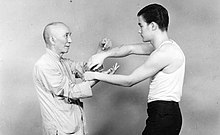
The afterwards 1960s and 1970s witnessed an increased media interest in Chinese martial arts, influenced past martial artist Bruce Lee. Bruce Lee is credited as ane of the first instructors to openly teach Chinese martial arts to Westerners.[20] Globe Judo Championships have been held since 1956, Judo at the Summertime Olympics was introduced in 1964. Karate World Championships were introduced in 1970.
The "kung fu wave" of Hong Kong action cinema in the 1970s, particularly Bruce Lee films, popularized martial arts in global popular civilisation. A number of mainstream films produced during the 1980s also contributed significantly to the perception of martial arts in Western popular civilization. These include The Karate Kid (1984) and Bloodsport (1988). This era produced some Hollywood activeness stars with martial arts groundwork, such as Jean-Claude Van Damme and Chuck Norris.
Also during the 20th century, a number of martial arts were adapted for self-defense purposes for military mitt-to-hand gainsay. World War II combatives, KAPAP (1930s) and Krav Maga (1950s) in Israel, Systema in Soviet-era Russian federation, and Sanshou in the People's Commonwealth of China are examples of such systems. The United states military de-emphasized hand-to-hand combat grooming during the Cold War menses, just revived it with the introduction of LINE in 1989.
1990 to nowadays [edit]
In 1993, the first Pancrase event was held in Nihon.[21] The 1000-1 rules of kickboxing were introduced, based on 1980s Seidokaikan karate.[ citation needed ]
During the 1990s, Brazilian jiu-jitsu became popular and proved to be effective in mixed martial arts (MMA) competitions such equally the UFC and PRIDE.[22]
Jackie Chan and Jet Li are prominent martial artists who take become major movie figures. Their popularity and media presence has been at the forefront for promoting Chinese martial arts since the late 20th and early 21st centuries.[ commendation needed ]
With the continual discovery of more medieval and Renaissance fighting manuals, the practice of Historical European Martial Arts and other Western Martial Arts have been growing[ citation needed ] in popularity beyond the U.s.a. and Europe.[ citation needed ]
On 29 Nov 2011, UNESCO inscribed Taekkyon onto its Intangible Cultural Heritage of Humanity List.[23]
Revival [edit]
Many styles of Indian martial arts were banned by the colonial government during the flow of British rule in India, which led to a decline in their popularity.[24] Some, such as Kalaripayattu, did not undergo such declines since they were mostly practised in areas of the Indian subcontinent outside direct British command. Other Indian martial fine art, such equally Silambam, while non widely good in India, continue to be practiced in other countries in the Indian cultural sphere such as Republic of indonesia and Malaysia. Many other Indian martial arts such every bit Mardhani Khel and Paika Akhada survived by practitioners practicing the art in undercover, or by telling the colonial authorities that it was a class of dance. While many regional Indian martial arts forms are fading into obscurity, martial arts such as Gatka and Kalaripayattu are experiencing a gradual resurgence.[25]
Testing and competition [edit]
Testing or evaluation is of import to martial artists of many disciplines who wish to determine their progression or own level of skill in specific contexts. Students often undergo periodic testing and grading past their own teacher in order to advance to a college level of recognized achievement, such every bit a different belt color or championship. The type of testing used varies from system to system only may include forms or sparring.
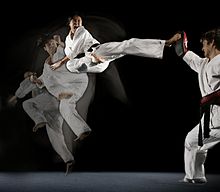
Various forms and sparring are commonly used in martial fine art exhibitions and tournaments. Some competitions pit practitioners of different disciplines against each other using a common set of rules, these are referred to as mixed martial arts competitions. Rules for sparring vary between art and system simply can generally exist divided into light-contact, medium-contact, and full-contact variants, reflecting the corporeality of force that should be used on an opponent.
Light- and medium-contact [edit]
These types of sparring restrict the amount of strength that may be used to striking an opponent, in the case of light sparring this is usually to 'affect' contact, e.yard. a punch should be 'pulled' as soon as or earlier contact is made. In medium-contact (sometimes referred to every bit semi-contact) the dial would non exist 'pulled' merely non hit with full force. As the amount of strength used is restricted, the aim of these types of sparring is not to knock out an opponent; a point system is used in competitions.
A referee acts to monitor for fouls and to command the match, while judges mark down scores, as in battle. Particular targets may be prohibited, certain techniques may be forbidden (such as headbutting or groin hits), and fighters may exist required to wear protective equipment on their head, hands, breast, groin, shins or feet. Some grappling arts, such as aikido, utilise a similar method of compliant training that is equivalent to light or medium contact.
In some styles (such as fencing and some styles of taekwondo sparring), competitors score points based on the landing of a single technique or strike as judged by the referee, whereupon the referee will briefly stop the match, award a point, then restart the match. Alternatively, sparring may keep with the betoken noted past the judges. Some critics of point sparring feel that this method of training teaches habits that result in lower combat effectiveness. Lighter-contact sparring may be used exclusively, for children or in other situations when heavy contact would be inappropriate (such every bit beginners), medium-contact sparring is often used equally training for full contact.
Total-contact [edit]
Full-contact sparring or competition, where strikes or techniques are not pulled but used with total force every bit the name implies, has a number of tactical differences from calorie-free and medium-contact sparring. It is considered past some to exist requisite in learning realistic unarmed gainsay.[26]
In total-contact sparring, the aim of a competitive match is to knock out the opponent or to forcefulness the opponent to submit. Where scoring takes place information technology may be a subsidiary measure, just used if no articulate winner has been established by other ways; in some competitions, such as the UFC 1, there was no scoring, though nigh at present utilize some form of judging equally a backup.[27] Due to these factors, full-contact matches tend to be more aggressive in character, but rule sets may still mandate the employ of protective equipment, or limit the techniques allowed.
Well-nigh all mixed martial arts organizations such equally UFC, Pancrase, Shooto use a class of full-contact rules equally exercise professional boxing organizations and Yard-one. Kyokushin karate requires advanced practitioners to appoint in bare-knuckled, full-contact sparring allowing kicks, knees and punching although punching to the head is disallowed while wearing just a karate gi and groin protector. Brazilian jiu-jitsu and judo matches do not allow striking, but are full-contact in the sense that full strength is practical in the permitted grappling and submission techniques. Competitions held past World Taekwondo requires the utilise of Headgear and padded vest, merely are total contact in the sense that full force is applied to strikes to the head and body, and win past knockout is possible.
Martial sport [edit]
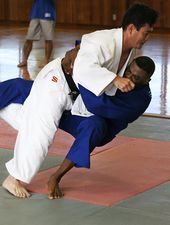
Martial arts have crossed over into sports when forms of sparring go competitive, becoming a sport in its own right that is dissociated from the original antagonistic origin, such equally with western fencing. The Summer Olympic Games includes judo, taekwondo, western archery, boxing, javelin, wrestling and fencing every bit events, while Chinese wushu recently failed in its bid to be included, just is even so actively performed in tournaments across the globe. Practitioners in some arts such as kickboxing and Brazilian jiu-jitsu oftentimes train for sport matches, whereas those in other arts such as aikido mostly spurn such competitions. Some schools believe that competition breeds better and more efficient practitioners, and gives a sense of good sportsmanship. Others believe that the rules under which competition takes place have diminished the combat effectiveness of martial arts or encourage a kind of do which focuses on winning trophies rather than a focus such every bit cultivating a item moral character.
The question of "which is the all-time martial fine art" has led to inter style competitions fought with very few rules allowing a diverseness of fighting styles to enter with few limitations. This was the origin of the start Ultimate Fighting Championship tournament (later renamed UFC 1: The Commencement) in the U.s. inspired past the Brazilian Vale tudo tradition and forth with other minimal rule competitions, well-nigh notably those from Japan such every bit Shooto and Pancrase, have evolved into the gainsay sport of Mixed Martial Arts (MMA).
Some martial artists compete in non-sparring competitions such as breaking or choreographed routines of techniques such equally poomse, kata and aka, or modern variations of the martial arts which include dance-influenced competitions such as tricking. Martial traditions take been influenced by governments to become more than sport-similar for political purposes; the central impetus for the endeavour by the People's Republic of Cathay in transforming Chinese martial arts into the committee-regulated sport of wushu was suppressing what they saw as the potentially subversive aspects of martial preparation, particularly nether the traditional arrangement of family unit lineages.[28]
Health and fettle benefits [edit]
Martial arts training aims to result in several benefits to trainees, such as their concrete, mental, emotional and spiritual health.[29]
Through systematic practice in the martial arts a person's physical fitness may be boosted (strength, stamina, speed, flexibility, movement coordination, etc.) as the whole body is exercised and the unabridged muscular arrangement is activated.[ citation needed ] Beyond contributing to physical fettle, martial arts preparation besides has benefits for mental health, contributing to self-esteem, self-command, emotional and spiritual well-being. For this reason, a number of martial arts schools have focused purely on therapeutic aspects, de-emphasizing the historical aspect of self-defense force or combat completely.[ citation needed ]
Co-ordinate to Bruce Lee, martial arts also take the nature of an fine art, since there is emotional communication and consummate emotional expression.[ citation needed ]
Self-defense, war machine and law enforcement applications [edit]

Some traditional martial concepts have seen new use within mod military training. Perhaps the well-nigh recent example of this is point shooting which relies on muscle memory to more effectively utilize a firearm in a variety of awkward situations, much the fashion an iaidoka would master movements with their sword.

During the World War II era William Due east. Fairbairn and Eric A. Sykes were recruited by the Special Operations Executive (SOE) to teach their martial art of Defendu (itself drawing on Western boxing and Jujutsu) and pistol shooting to United kingdom of great britain and northern ireland, Us, and Canadian special forces. The book Kill or Become Killed, written by Colonel Rex Applegate, was based on the Defendu taught by Sykes and Fairbairn. Both Fairbairn's Get Tough and Appelgate's Kill or Get Killed became archetype works on hand-to-hand combat.[ citation needed ]
Traditional paw-to-hand, pocketknife, and spear techniques go along to see use in the composite systems adult for today's wars. Examples of this include European Unifight, the United states of america Army's Combatives organisation developed past Matt Larsen, the Israeli army'due south KAPAP and Krav Maga, and the Us Marine Corps's Marine Corps Martial Arts Program (MCMAP). Unarmed dagger defenses identical to those establish in the manual of Fiore dei Liberi and the Codex Wallerstein were integrated into the U.Due south. Army's training manuals in 1942[30] and proceed to influence today's systems along with other traditional systems such as eskrima and silat.[ citation needed ]
The rifle-mounted bayonet which has its origin in the spear, has seen use by the United states of america Army, the Usa Marine Corps, and the British Army every bit recently as the Republic of iraq War.[31]
Many martial arts are too seen and used in Law Enforcement paw-to-mitt training. For case, the Tokyo Anarchism Constabulary's use of aikido.[32]
Martial arts industry [edit]
Martial arts since the 1970s has become a significant industry, a subset of the wider sport industry (including movie house and sports television).[ citation needed ]
Hundreds of millions of people worldwide practice some class of martial art. Web Japan (sponsored by the Japanese Ministry building of Foreign Diplomacy) claims there are 50 million karate practitioners worldwide.[33] The Due south Korean government in 2009 published an estimate that taekwondo is skillful by 70 million people in 190 countries.[34]
The wholesale value of martial arts related sporting equipment shipped in the United states of america was estimated at Usa$314 1000000 in 2007; participation in the same yr was estimated at half dozen.nine million (ages 6 or older, 2% of Us population).[35] R. A. Court, CEO of Martial Arts Aqueduct, stated the full revenue of the US martial arts industry at US$xl billion and the number of U.s.a. practitioners at 30 one thousand thousand in 2003.[36]
Equipment [edit]
Martial arts equipment can include that which is used for conditioning, protection and weapons. Specialized workout equipment can include breaking boards, dummy partners such as the wooden dummy, and targets such as punching bags and the makiwara. Protective equipment for sparring and competition includes boxing gloves, headgear and mouthguards.[37]
Martial arts fraud [edit]
Asian martial arts experienced a surge of popularity in the west during the 1970s, and the ascension demand resulted in numerous low quality or fraudulent schools. Fueled by fictional depictions in martial arts movies, this led to the ninja craze of the 1980s in the The states.[38] There were too numerous fraudulent ads for martial arts training programs, inserted into comic books circa the 1960s and 1970s, which were read primarily by adolescent boys.[39]
In the seventies, lower ranks (kyu) began to be given colorful belts to prove progress. This proved to be commercially feasible and colored-chugalug systems were adopted in many martial arts caste mills (also known every bit McDojos and belt factories) as a means to generate additional greenbacks. This was covered in the Penn & Teller: Bullshit! episode "Martial Arts" (June 2010).[ citation needed ]
Run across also [edit]
- Martial arts timeline
- History of martial arts
- List of martial arts
References [edit]
- ^ "martial art | Definition, History, Types, & Facts". Encyclopedia Britannica . Retrieved 13 January 2020.
- ^ Bowman, Paul (2021). The Invention of Martial Arts: Popular Culture Between Asia and America. Oxford University Press. ISBN978-0-nineteen-754033-half dozen.
- ^ Clements, John (January 2006). "A Short Introduction to Historical European Martial Arts" (PDF). Meibukan Magazine (Special Edition No. i): 2–4. Archived from the original (PDF) on 18 March 2012. Retrieved 21 December 2012.
- ^ Lewis, Dan (22 April 1973). "Newest Flick Craze: Chinese Agents". Lima News. p. 30. Retrieved 15 Apr 2022 – via NewspaperArchive.
Outset at that place were "spaghetti westerns" made in Italy, and then the Spanish got into the act and they became "gaspacho westerns."
Now, there's going to be an invasion of "grub mein spies." It'south the newest rage, the superhero Chinese agent, who takes on 84 adversaries at in one case and pounds them into the ground — without a unsafe weapon, except his easily and his anxiety.
They're coming hither under the label of "martial sciences," an umbrella label that takes in all of the oriental arts of cocky-defence force, such as karate, jujitso, kung fu and so on.
They're made in Hong Kong and the biggest hero of them all at the moment, surely the biggest box-office attraction there, is a face pretty familiar to American television audiences. Remember Bruce Lee, the swift, agile oriental chauffeur in "The Green Hornet"?
(...) Lee already has starred in iii Chinese boxer (another label) pictures and there are several dozen others available to the international market place. They reportedly are sweeping the European market and have just started to infiltrate the American scene.
Warner Brothers has simply released ane chosen "The 5 Fingers of Death" and, with Fred Weintraub as producer, is at present involved in the first American-Chinese production of a martial-science moving picture, a film that stars Bruce (Kato) Lee. - ^ Donn F. Draeger and P'ng Chye Khim (1979). Shaolin Lohan Kung-fu. Tuttle Publishing.
- ^ Team, Author Sportsver (28 March 2020). "Taekwondo in a Street Fight: Effective for Self-defense?". Sportsver . Retrieved xv April 2022.
- ^ official IZSF
- ^ Martial arts at Encyclopædia Iranica
- ^ "Pahlevani and Zoorkhanei rituals".
{{cite spider web}}: CS1 maint: url-status (link) - ^ a b Hamblin, William J. (2006). Warfare in the aboriginal Virtually East to 1600 BC : holy warriors at the dawn of history (Repr. ed.). New York: Routledge. p. fifteen. ISBN978-0415255899.
- ^ Nash, George, "Assessing rank and warfare strategy in prehistoric hunter-gatherer society: a written report of representational warrior figures in rock-art from the Castilian Levant" in: M. Parker Pearson & I.J.N. Thorpe (eds.), Warfare, violence and slavery in prehistory: proceedings of a Prehistoric Society conference at Sheffield University, 2005, Archaeopress, ISBN 1841718165, 978-1841718163, Fully online, Bristol University
- ^ "Wrestling". Encyclopedia Britannica . Retrieved 2 September 2019.
- ^ Michael Poliakoff. "Encyclopædia Britannica entry for Boxing". Britannica.com . Retrieved 18 May 2013.
- ^ "Sun Tzu Biography and Introduction: Sun Tzu The Fine art of War and Strategy Site past". Sonshi. Com. Retrieved 7 November 2010.
- ^ Reid, Howard and Croucher, Michael (1983). The Style of the Warrior – The Paradox of the Martial Arts. New York: Overlook Printing[ ISBN missing ] [ folio needed ]
- ^ "Actualizing Power and Crafting a Cocky in Kalarippayattu". spa.exeter.ac.uk . Retrieved 29 February 2016.
- ^ "Roman Games, Chariot Races & Spectacle". Earth History Encyclopedia . Retrieved 12 November 2021.
- ^ "Lonsdale Belt | boxing | Britannica". www.britannica.com . Retrieved ane March 2022.
- ^ Berreby, David (28 August 1988). "The Martial Arts as Moneymakers". The New York Times . Retrieved 4 December 2010.
- ^ "Jeet Kune Do". absolutedefense.net. Archived from the original on 17 July 2014. Retrieved 27 May 2014.
- ^ "The origins, history and rules from the early days of Pancrase circa 1993". bloodyelbow.com. 29 March 2014. Retrieved 27 May 2014.
- ^ "fighting art used in the UFC". UFC.com. Archived from the original on 23 May 2010. Retrieved vii Nov 2010.
- ^ "UNESCO Culture Sector – Intangible Heritage – 2003 Convention". UNESCO.org.
- ^ Tandon, Nikita. "Reviving the Lost Martial Arts of India". The Armchair Lounge. Archived from the original on 21 August 2018. Retrieved 1 March 2016.
- ^ Manoharan, Suresh K. "History of Varmakalai". www.varmam.org . Retrieved 1 March 2016.
- ^ "Aliveness 101". Directly Blast gym. Archived from the original on 7 Jan 2009. Retrieved three November 2008. – An essay on contact levels in grooming
- ^ Dave Meltzer (12 November 2007). "Offset UFC forever altered combat sports". Yahoo! Sports. Archived from the original on iv June 2011. Retrieved 3 November 2008.
- ^ Fu, Zhongwen (2006) [1996]. Mastering Yang Style Taijiquan. Berkeley, California: Bluish Snake Books.
- ^ Bu, Bin; Haijun, Han; Yong, Liu; Chaohui, Zhang; Xiaoyuan, Yang; Singh, Maria Fiatarone (2010). "Effects of martial arts on health condition: A systematic review". Journal of Testify-Based Medicine. three (4): 205–219. doi:x.1111/j.1756-5391.2010.01107.ten. PMID 21349072. S2CID 41065668.
- ^ Vail, Jason (2006). Medieval and Renaissance Dagger Gainsay. Paladin Press. pp. 91–95.
- ^ Sean Rayment (13 June 2004). "British battalion 'attacked every 24-hour interval for six weeks'". The Daily Telegraph. London. Archived from the original on 11 January 2022. Retrieved xi December 2008.
- ^ Twigger, R. (1997). Angry White Pyjamas. London: Phoenix. ISBN 978-0753808580[ page needed ]
- ^ "Martial Arts : Fact Sheet" (PDF). Web-japan.org. Retrieved xiii August 2015.
- ^ Kim, H.-Southward. (2009): Taekwondo: A new strategy for Make Korea Archived 23 July 2011 at the Wayback Machine (21 December 2009). Retrieved on viii January 2010.
- ^ Jack Westward. Plunkett (2009). Plunkett'due south Sports Industry Almanac, ISBN 978-1593921408.
- ^ Blackness Chugalug Magazine September 2003, p. 20.
- ^ "The Importance Of A Mouthguard When Playing Sport". Orthodontics Australia. 21 February 2020. Retrieved 6 October 2020.
- ^ see "The Existent Deal, The Buzzwords and the Latest Trend" Blackness Belt Magazine, June 1999, p. 78.
- ^ Tom Heintjes (20 June 2017). "The Deadliest Ads Alive! | Hogan's Alley". Cartoonician.com. Archived from the original on 25 August 2015. Retrieved 13 Baronial 2015.
Source: https://en.wikipedia.org/wiki/Martial_arts
0 Response to "Martia Arts How Long Does It Take for Actors to Learn Their Own Stunts"
Post a Comment